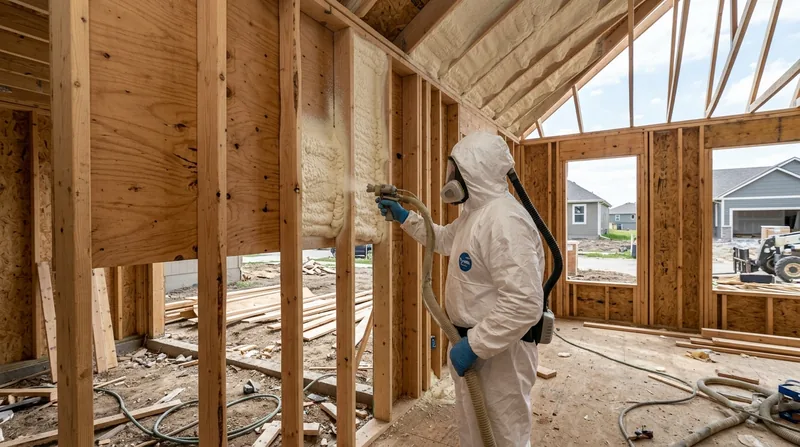




Commercial & New Construction Spray Foam in Topeka is the insulation choice for builders and property owners who want the thermal envelope right from the start. New subdivisions spreading west and south of Topeka, along with commercial shells across Shawnee County and the surrounding counties, benefit most from spray foam applied during framing or before drywall closes. Unlike retrofit work in older homes near Potwin, College Hill, or the Statehouse district, new construction spray foam is installed cleanly, inspected easily, and specified to code before the building is occupied. Whether you are building a warehouse in Leavenworth, a retail shell in Olathe, a residential subdivision in Gardner, or an industrial facility in Manhattan, spray foam delivers the air seal and R-value that code and performance demand. We quote commercial and new construction projects across the region, with written estimates that specify R-value, thickness, and the material best suited to your climate zone and use.
Why Commercial & New Construction Spray Foam Matters in Topeka's Building Climate
Topeka sits in IECC climate zone 4A, mixed-humid, with hot humid summers and cold windy winters. New construction must handle both: summer moisture drive pushing inward from outside, and winter heating losses through walls, roofs, and band joists. Spray foam solves both at once. It creates a continuous air barrier that stops infiltration, reduces the load on HVAC equipment, and holds R-value consistently across the entire envelope. Builders in newer subdivisions toward the west and south of Topeka, as well as commercial developers across the county, know that spray foam cuts callbacks, eliminates punch-list air leaks, and meets or exceeds energy code without compromise.
- We spray open cell foam in attics and walls of residential new construction where cost and sound control matter most.
- We apply closed cell foam to metal building shells, commercial roofs, and rim joists where condensation control and high R-value per inch are the priority.
- We coordinate with your general contractor and building official to ensure permits, thermal barriers, and ignition barriers meet local code before we spray.
- We provide written estimates with R-value and thickness specifications so your plans are clear and your inspector has what he needs.
- We remove and replace failed or undersized insulation in existing structures before new construction starts, clearing the substrate for a clean spray.
Spray foam in new construction is not a retrofit gamble; it is a specification you build into the envelope from day one.
Key info: Topeka's building code and the code in force at your address (Lawrence, Manhattan, Lenexa, Olathe, Shawnee, Gardner, or surrounding areas) govern attic ventilation, thermal barriers, and ignition barriers. We help you navigate what applies; the building official makes the call. Always verify requirements with your local building department before we schedule.
For more on how spray foam works in attics, see our guide to Attic Spray Foam Insulation in Topeka.
How We Approach Commercial & New Construction Spray Foam Projects in Greater Topeka
Commercial and new construction spray foam is measured, scheduled, and inspected differently than residential retrofit work. We start with a site walk, a review of plans if they exist, and a clear conversation about your timeline and budget. From there, we coordinate with your GC, your mechanical contractor, and the building official to ensure the spray happens at the right stage, with the right material, and with proper documentation for inspection. We spray to specification, control our passes to avoid over-application, and provide a written report of what was installed and where.
- We schedule the spray around your framing and mechanical rough-in, so foam does not interfere with ductwork, plumbing, or electrical runs.
- We set up mechanical ventilation during and after the spray to control fumes and accelerate cure, following manufacturer guidelines strictly.
- We spray to the thickness and density specified in your estimate, with board-foot counts recorded on site.
- We install thermal barriers and ignition barriers as required by code, with the building official's approval before we leave the job.
- We provide a completion report that documents material used, coverage area, R-value achieved, and any special conditions or restrictions for the space.
This process protects you, your builder, and your inspector, and it keeps the job on schedule.
Example: A new warehouse shell in Lenexa required closed cell foam on the band joist and rim to prevent condensation on cold steel during humid summers. We coordinated with the GC to spray after the concrete cure but before the HVAC ductwork arrived, then provided the thickness and R-value documentation the inspector needed. The job stayed on schedule and the building performed as designed.
For details on how we handle Closed Cell Spray Foam in Topeka, see our technical guide.
Commercial & New Construction Spray Foam Methods and Materials
| Approach | Description | Best for |
|---|---|---|
| Open Cell Spray Foam | Low-density foam (0.5 lb/cu ft) that expands fully and allows vapor to pass through. R-value 3.6 per inch. Softer, sound-dampening, lower cost per board foot. | Residential attics, walls, and interior cavities where cost matters and condensation risk is low. New homes in Topeka's newer subdivisions. |
| Closed Cell Spray Foam | High-density foam (1.5-2.0 lb/cu ft) that stops vapor and water. R-value 6.0 to 7.0 per inch. Rigid, moisture-resistant, higher cost per board foot but thinner for same R-value. | Metal building shells, band joists, rim joists, roofs, and any assembly where condensation control or moisture resistance is critical. |
| Injection Foam Retrofit | Low-pressure injection of closed cell foam into existing wall cavities, band joists, and rim joists without demolition. Fills gaps and seals air leaks in place. | Existing commercial buildings, older warehouses, and residential retrofits where walls cannot be opened and air sealing is the goal. |
| Removal and Replacement | Mechanical removal of failed, undersized, or contaminated insulation, followed by new spray foam installation to specification. Includes proper disposal and substrate prep. | Commercial buildings with degraded insulation, new construction sites with existing structures, and any retrofit where a clean substrate is required. |
Commercial & New Construction Spray Foam Cost in Topeka: What to Expect
Commercial and new construction spray foam pricing depends on the material chosen, the area to be sprayed, the thickness and R-value specified, site access, and the complexity of the job. A free commercial estimate is the only honest starting point. We visit the site, review your plans or scope, measure the area, and provide a written estimate with R-value, thickness, and material specified. From there, the cost factors that move the price are clear: whether you choose open cell or closed cell foam, how many board feet are needed, whether existing insulation must be removed first, and whether thermal or ignition barriers are required by code.
New construction projects in Topeka's west and south subdivisions, as well as commercial shells in Lenexa, Olathe, Gardner, and Manhattan, typically run $2,000 to $15,000 or more, depending on building size and complexity. A small residential new build attic might be $2,500 to $5,000. A commercial warehouse roof or metal building shell could be $10,000 to $30,000 or higher. The only way to know is to call us at (785) 329-9236 for a free estimate, no obligation.
Getting 2 or 3 estimates from different contractors is smart. Compare the R-value and thickness specified, not just the total price. A low bid with no thickness spec or a vague material description is a red flag. Our written estimates include everything you need to verify quality and meet code. See our full pricing overview for more context.
What to Look for When Hiring a Spray Foam Insulation Contractor Near Topeka
Spray foam contractors range from local independent shops to national franchises to one-man operations that spray a job in an afternoon and disappear. The best way to protect yourself is to verify a few things before you hire. Ask for proof of current insurance, and confirm the coverage amount matches your project size. Request references from recent commercial or new construction jobs in your area. Topeka and surrounding areas like Lawrence, Manhattan, and Olathe have local building departments; call them to verify that the contractor has pulled permits on recent jobs and that inspections passed. Ask for written estimates that specify R-value, thickness, material type, and the thermal or ignition barrier strategy required by your local code. A contractor who cannot or will not put those details on paper is not worth hiring.
For HOA-governed master-planned communities in newer subdivisions, check your architectural guidelines to see if exterior or visible insulation work requires approval. Most HOA rules do not touch insulation, but they may govern appearance or access during construction. Ask your GC or building owner if there are any special restrictions.
Finally, ask how the contractor handles ventilation during the spray and what re-entry window they recommend. Correct installation means controlled passes, proper drum temperature and ratio, mechanical ventilation during cure, and a stated 24 to 48 hour re-entry window. If a contractor promises immediate re-entry or skips ventilation, walk away. For a free estimate and a chance to ask these questions directly, contact us or call (785) 329-9236.
Commercial & New Construction Spray Foam in Topeka: Pricing Guide
| Service | Price | Details |
|---|---|---|
| Free Commercial Estimate | Free | Site visit, scope review, written R-value and thickness specifications, no obligation to book |
| Residential New Construction Attic | Starting at $2,500 | Open or closed cell foam, typical attic 1,200 to 1,800 sq ft, R-30 to R-49 depending on material and code |
| Commercial Shell or Metal Building | Starting at $5,000 | Closed cell foam on roof deck, band joist, or walls; pricing scales with square footage and thickness required |
| Removal and Replacement | On estimate | Mechanical removal of existing insulation, disposal, substrate prep, then new spray foam installation; cost depends on volume and contamination |
| Travel | Included | No separate mileage fee or travel charge within Topeka and surrounding counties |
| Estimate Response | Within 24 hours | Call (785) 329-9236 to schedule; free estimate, no credit card required, no sales pressure |
Indicative pricing, the exact cost depends on square footage, finish, and site access. Free personalized estimate within 24h at (785) 329-9236.


