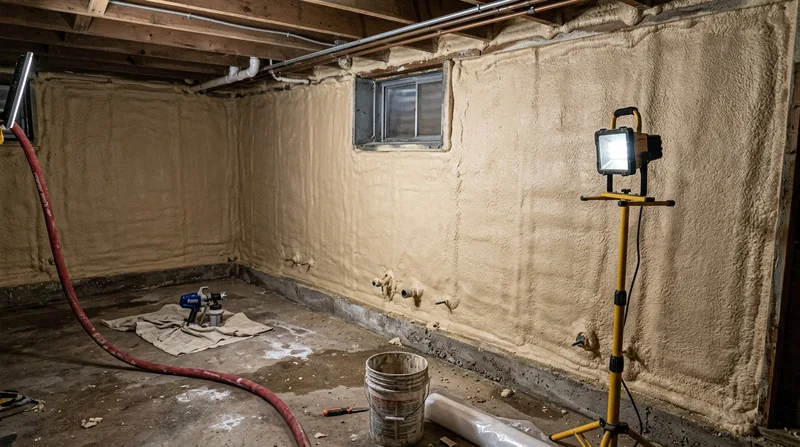




Closed cell spray foam insulation in Topeka stops moisture where it does the most damage: in rim joists after spring thaw, in basement walls after heavy rain, and in metal buildings where condensation sweats through steel. Topeka's housing stock ranges from century-old Victorians in Potwin and College Hill to mid-century ranches across Westboro and newer subdivisions toward the south and west. Most sit over basements that stay damp after rain, with crawl spaces and slabs on newer properties. The climate here is mixed-humid, IECC zone 4A, with hot summers that push moisture inward and cold winters that drive it back out. Closed cell foam resists that seasonal vapor drive better than any other insulation, and it holds its R-value in the cold and damp where it matters most. We have been doing this work since 2012, and we know which jobs in Topeka need closed cell and which ones do not.
Why Closed Cell Spray Foam Works in Topeka's Damp Basements and Cold Rim Joists
Topeka basements flood after heavy rain. Rim joists and band joists, the band of wood that sits on top of the foundation wall, take a beating from moisture in summer and cold in winter. Older homes in Potwin, College Hill and around the Statehouse often have vented crawl spaces that let in ground moisture year-round. Closed cell foam stops air infiltration and resists water absorption where open cell foam and fiberglass fail. It also holds its R-value in cold conditions, which matters in Kansas winters.
- Closed cell foam resists water absorption in wet basement and rim joist applications.
- It maintains its R-value in cold rim joist areas where winter air infiltration costs money.
- The foam creates an air barrier that stops moisture-laden air from entering the wall cavity.
- It works in metal outbuildings and barndominiums across Shawnee County where condensation on steel is the dominant failure mode.
These properties make closed cell the right choice for the damp and cold zones in and around Topeka homes.
Key info: Topeka's rim joists and basement walls face both summer humidity and winter cold. Closed cell foam stops vapor drive in both directions, unlike fiberglass or open cell, which absorb moisture. That moisture resistance is why closed cell is the standard for Topeka's damp basement season.
For more detail on how closed cell compares to open cell, see our guide to open cell spray foam insulation in Topeka.
The Kansas Building Code and local building departments in Topeka, Lawrence, Manhattan, Leavenworth and other cities in the region govern ventilation, thermal barriers and ignition barriers for spray foam work. The fifteen-minute thermal barrier rule is often misunderstood, and requirements vary by jurisdiction. Always check with your local building department before any spray foam work begins. You can find Topeka's building code and permit requirements at the Topeka Planning and Development Department.
How We Install Closed Cell Spray Foam in Topeka Basements, Rim Joists and Metal Buildings
Closed cell spray foam starts with a clean, dry substrate. We do not spray over wet basement walls, leaking rim joists or standing water. If moisture is present, we address the source first or we walk away. Once the surface is ready, we spray the foam in controlled passes, holding thickness and ratio to manufacturer spec. Mechanical ventilation runs during cure to clear VOCs. We do not promise immediate re-entry; we state a twenty-four to forty-eight hour cure window, and we mean it.
- We inspect the rim joist, basement wall or metal building surface for moisture, damage or contamination before any foam is applied.
- We dry the substrate if needed or recommend repair before we spray.
- We spray closed cell foam in controlled passes at the manufacturer ratio and drum temperature, holding thickness per pass.
- We run mechanical ventilation during cure and provide a written re-entry window.
- We provide a written estimate with R-value and thickness specs so you know exactly what you are paying for.
This method ensures the foam cures properly and delivers the R-value and moisture resistance you are paying for.
Example: A Topeka homeowner in Westboro calls with a damp basement rim joist after spring thaw. We inspect the rim, see condensation and a small water stain from last year's rain. We dry the rim, seal any gaps, then spray two inches of closed cell foam. The foam stops air infiltration, resists the moisture that will come in summer, and holds its R-value through the winter. Cost is on estimate, but the job typically runs $800 to $1,200 depending on rim length and access. We provide a written estimate with R-value and thickness before we schedule.
If you also need to remove old insulation or air-seal other areas, see our pages on insulation removal in Topeka and air sealing in Topeka.
Closed Cell Spray Foam Methods and Applications in Topeka
| Application | Description | Why Closed Cell Works Here |
|---|---|---|
| Rim and Band Joists | Two to three inches of closed cell foam sprayed on the band of wood sitting on the foundation wall, stopping air infiltration and moisture entry. | Rim joists in Topeka face both summer humidity and winter cold. Closed cell resists water absorption and maintains R-value in freezing conditions. |
| Basement Walls and Crawl Spaces | Closed cell foam sprayed on concrete or block basement walls and crawl space ceilings to stop moisture infiltration and air leakage. | Topeka basements stay damp after rain. Closed cell foam does not absorb water and creates an air barrier that stops humid air from entering the cavity. |
| Metal Buildings and Barndominiums | Closed cell foam sprayed on the underside of metal roof decks and walls to stop condensation and provide thermal resistance. | Metal buildings across Shawnee County sweat in summer. Closed cell foam stops condensation on cold steel and resists the moisture that forms inside the building. |
| Sealed Attic Decks (New Construction) | Closed cell foam sprayed on the underside of roof sheathing in new construction or attic retrofits to create a sealed, conditioned attic space. | Sealed attics in Topeka eliminate the summer cooling load from vented attics. Closed cell provides high R-value in a thin profile and resists summer humidity. |
| Wall Cavity Injection Foam | Closed cell foam injected into the cavities of existing exterior walls (pre-1980 homes) without demolition. | Topeka's older homes in Potwin and College Hill have uninsulated or poorly insulated walls. Closed cell fills the cavity and stops air infiltration from the outside. |
Closed Cell Spray Foam Insulation Cost in Topeka: What to Expect
Closed cell spray foam in Topeka starts at around $1.20 per board foot for small rim joist and band joist jobs. A typical rim joist job in a Topeka basement might run 200 to 400 board feet, putting the material cost in the range of $240 to $480. Labor, equipment and overhead add $400 to $800, so a rim joist job typically totals $800 to $1,200. Larger projects like a sealed attic deck or a metal building interior can run $2,000 to $8,000 or more, depending on square footage, access and existing insulation that needs removal.
Several factors move the price up or down. Access matters: a rim joist that is easy to reach costs less than one buried behind stored items or in a tight crawl space. Substrate condition is critical: if the rim is wet or has old insulation that needs removal first, the job takes longer and costs more. Existing insulation removal is a separate line item. Travel is included in Topeka and surrounding areas, so you will not see a mileage fee added on. Always get two or three written estimates before choosing a contractor. Each estimate should include R-value and thickness specs so you can compare apples to apples.
For a full breakdown of pricing and what affects the final number, see our pricing overview.
What to Look for When Hiring a Closed Cell Spray Foam Insulation Contractor Near Topeka
Hiring a spray foam contractor is not like hiring a plumber or electrician. The licensing regime for spray foam work in Kansas has not been standardized, so there is no single license to verify. What matters is insurance, references, and a clear written estimate with R-value and thickness. A reputable contractor will provide a free estimate within twenty-four hours, explain what closed cell is and why it works for your job, and walk you through the cure window and re-entry timeline. They will also tell you when closed cell is not the right choice (for example, a simple attic top-up on a sound attic may call for blown-in insulation instead).
- Verify the contractor is fully insured and ask for a certificate of insurance that covers spray foam work.
- Get a written estimate that lists R-value, thickness in inches, and the area to be covered in square feet or board feet.
- Ask for references from at least three recent jobs in Topeka, Lawrence or nearby cities and call them.
- Ask about the cure window and re-entry timeline, and expect twenty-four to forty-eight hours before the space is safe to occupy.
- Check that the contractor explains mechanical ventilation during cure and does not promise immediate re-entry.
- Confirm that the contractor addresses moisture before spraying and does not spray over wet substrates.
A contractor who skips the inspection, gives you a price with no R-value or thickness, promises immediate re-entry, or offers a price far below market is a red flag. Always verify any contractor's insurance and ask about their approach to moisture and substrate prep before you sign anything. If you have questions about what closed cell spray foam can do for your Topeka home, contact us for a free estimate.
Closed Cell Spray Foam Insulation in Topeka: Pricing Guide
| Service | Price | Details |
|---|---|---|
| Rim Joist and Band Joist Sealing | Starting at $1.20/board ft | Small jobs in accessible rim areas, typically 200 to 400 board feet, total cost $800 to $1,200 depending on substrate condition and existing insulation removal |
| Basement Wall or Crawl Space Foam | Starting at $1.20/board ft | Coverage of concrete or block walls and crawl space ceilings, cost varies by wall height, length and moisture present before spraying |
| Metal Building or Sealed Attic Deck | On estimate | Larger projects require on-site measurement of roof deck or building interior to calculate board footage and account for access, existing insulation and substrate prep |
| Wall Cavity Injection Foam Retrofit | On estimate | Retrofitting uninsulated exterior walls in older Topeka homes requires drilling, cavity inspection and custom foam volume, price depends on wall area and condition |
| Insulation Removal and Replacement | On estimate | Removing old or failed insulation before closed cell foam adds labor and disposal cost, quoted separately based on volume and substrate type |
| Free Estimate | No charge | Call (785) 329-9236 for a free, no-obligation written estimate with R-value and thickness specs, response within twenty-four hours |
Indicative pricing, the exact cost depends on square footage, finish, and site access. Free personalized estimate within 24h at (785) 329-9236.


